
The scale, sophistication and violent consequences of organised crime have become a serious threat to the EU’s security. Organised crime groups (OCGs) continue to endanger the values and functioning of our society, the safety, well-being and fundamental rights of our citizens, and the preservation of our economies and the rule of law.
Eurojust’s operational support to organised crime cases
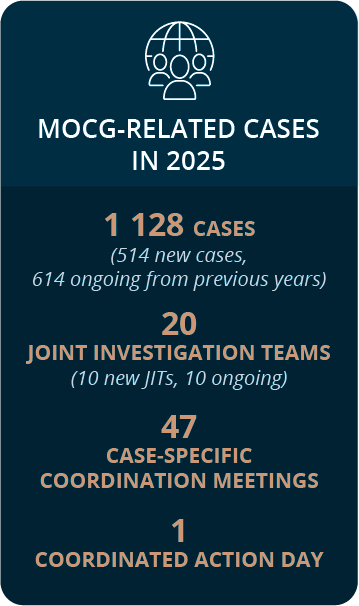
In 2025, Eurojust handled over 1 100 organised crime cases, including over 500 newly opened cases. The number of JITs and coordination meetings the Agency organised remained steady compared to the previous reporting year.
‘Crime as a Service’ is increasingly being adopted as a common modus operandi by organised crime groups. At the same time, access to data – including its retention and analysis – remains a key challenge in organised crime cases, many of which at Eurojust rely on evidence obtained from encrypted platforms and applications such as SkyECC and EncroChat. In this context, covert investigative measures, including undercover operations and the use of undercover agents, continue to be essential tools for dismantling OCGs.
Criminal network rolled up who stole over 7 000 artefacts
CRIME: A high value target (HVT) runs a large trafficking operation of valuable artefacts. The items with exceptional cultural and historical value were stolen from across Europe, including museums.
ACTION: After a house raid in 2020 in Bulgaria, 7 000 artefacts are seized and an investigation starts. Authorities find links between the HVT's network and individuals in other countries who supported the trafficking. An action day is planned to arrest the suspects and recover the stolen artefacts.
RESULT: Hundreds of coordinated actions in 2025 lead to 35 arrests in Bulgaria. 120 locations in Bulgaria are searched as well as places in France, Germany and Greece. Authorities seize over 3 000 artefacts. Follow-up actions lead to the seizure of nearly 30 000 artefacts.
EUROJUST'S ROLE: Eurojust facilitates the execution of EIOs and MLAs. To coordinate the searches taking place across Europe, a coordination centre is set up in The Hague to synchronise all actions.

Strategic developments impacting Eurojust’s organised crime casework
In 2025, Eurojust continued contributing to the EMPACT Operational Action Plan on High-Risk Criminal Networks (HRCN), which aims to identify and investigate high-value targets. Eurojust continued to co-lead four operational actions under this EMPACT priority in 2025, supporting the activities of judicial and law enforcement authorities against organised criminal networks. Due to the polycriminality associated with HRCNs, the operational actions addressed a wide range of crime areas.
At the same time, the Agency was preparing for the new EMPACT Cycle (2026-2029), during which Eurojust will continue its support and co-lead an action focusing on the judicial cooperation with Latin American countries, making use of its strong network with third countries.
 Eurojust is an agency of the European Union