
Environmental crime threatens entire ecosystems and poses serious risks to human health. It encompasses a wide range of illegal activities that intensify the three core dimensions of the global environmental crisis: climate change, pollution and biodiversity loss. Beyond its ecological and public health impacts, environmental crime is also one of the most profitable forms of illegal activity worldwide, making it a persistent and deeply rooted global challenge.
Eurojust's operational support to environmental crime cases
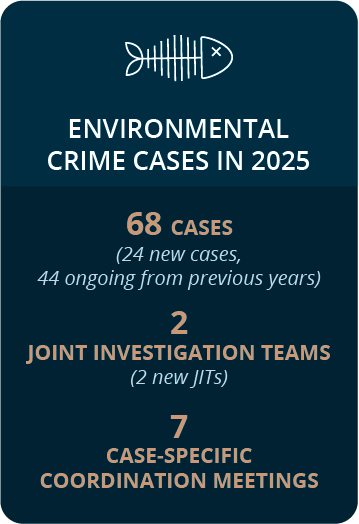
In 2025, Eurojust handled 68 environmental crime cases, a 17% increase over the previous year. Eurojust's casework in 2025 shows a growing number of cases involving the movement of illegal waste within the EU, including hazardous waste. This increase may be linked to differences between Member States in the cost of waste treatment, especially for hazardous waste. In addition, exporting waste outside the EU requires greater expertise and involves more complex procedures, which organised criminal networks may not always possess.
Environmental crime cases assisted by Eurojust are among the most complex ones, requiring extensive coordination and expertise. The cases involve numerous actors and require aligning diverse legal and investigative approaches applied across jurisdictions, including solving conflicts of jurisdiction.
Italy, followed by Romania and Slovenia initiated the most environmental crime cases at Eurojust in 2025. Germany was the country most frequently requested to assist in cross-border environmental cases handled by the Agency. No third country initiated environmental cases at Eurojust, with the United Kingdom being the only third country to be requested to assist in such cases.
Strategic developments impacting Eurojust's environmental crime casework
Cross-border environmental crime is often committed by organised criminal groups but remains under-prosecuted in Europe due to its complexity, limited specialised expertise, competing national priorities, and differences in legal definitions and penalties that hinder judicial cooperation.
Eurojust welcomes the Council of Europe Convention on the Protection of the Environment through Criminal Law, which the EU signed in December 2025. This landmark Convention complements the 2024 EU Directive on environmental crime, which defines environmental offences, sets minimum penalties for individuals and companies, and strengthens enforcement. While the Directive sets baseline rules for EU Member States, the Convention goes further by establishing a broader pan-European and international framework with binding standards to criminalise serious environmental offences and to impose effective, proportionate and dissuasive sanctions. This is especially relevant as Eurojust is strengthening its work with partners and countries outside the EU.
As Member States work to transpose the 2024 Directive – in which Eurojust's role is clearly defined in supporting stronger cross-border cooperation – in 2025, the Agency contributed to significantly raising awareness among practitioners of the new legal framework and sharing relevant best practices.
In 2025, Eurojust became an observer in EnviCrimeNet, the professional network of environmental law enforcement officers (in addition to already being an observer for several years in the European Network of Prosecutors for the Environment, ENPE).
 Eurojust is an agency of the European Union