
Terrorism in all its forms continues to pose a serious risk to the security of EU Member States, undermining democratic principles and the rule of law. The nature of terrorist threats has shifted over time, becoming more fragmented and complex, with dangers now arising from lone individuals (including minors), anti-government activists and groups with no clearly defined ideology. Terrorists also exploit new technologies, using online spaces for radicalisation, propaganda, recruitment and financing. The cross-border character of terrorist networks and operations makes enhanced information sharing and coordination essential for an effective judicial response.
Eurojust's operational support to terrorism cases
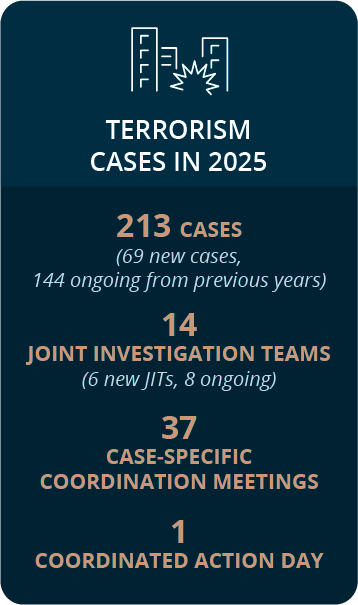
Combating terrorism remains a priority for the EU and in Eurojust's operational and strategic work. The Agency handled over 200 terrorism cases, marking an 11% increase from the previous year. These cases concerned terrorist threats and attacks, financing or incitement to terrorism, terrorist training and recruitment, and dissemination of terrorist propaganda. In certain instances, terrorist offences were investigated alongside other serious crimes, including participation in an organised crime group, illegal possession of firearms, fraud, murder, money laundering and cybercrime. Tragically, an additional challenge in some cases was the inclusion of minors, either as alleged perpetrators or victims.
Italy initiated the most terrorism cases at the Agency in 2025, followed by Germany, Portugal and Spain. Germany, followed by France, is the EU country most frequently requested to assist in cross-border terrorism cases. Switzerland was the third country to open the most terrorism cases at the Agency in 2025, while the United Kingdom and Ukraine were the third countries most frequently requested to assist.
Using its in-house expertise, Eurojust provided tailored legal and operational support, including coordinating parallel investigations, assisting with EAWs and extradition requests, facilitating the transfer of proceedings or the execution of EIOs, and mutual legal assistance requests concerning the gathering of information and evidence or hearing of witnesses. Six JITs were set up, bringing the total to 14 terrorism-related JITs in use in 2025.
Throughout the year, Eurojust continued to collect information from national authorities on ongoing or concluded criminal investigations, prosecutions, court proceedings or decisions on terrorist offences through the European Judicial Counter-Terrorism Register (CTR) and supported several investigations and prosecutions on the basis of such information. Thanks to the register and its integration with the agency's Case Management System, Eurojust is able to help EU Member States identify links between individuals and networks involved in ongoing and past investigations throughout the EU concerning terrorism and other crime types.
Arson terrorist group taken to court
CRIME: A terrorist group is suspected of carrying out arson attacks across Europe. They attempt to set fire to commercial, transport and factory facilities. The group is suspected of having links to a foreign intelligence service.
ACTION: Czech, Lithuanian, Polish and Romanian authorities identify links between the attacks and find the group and the organisers connecting the suspects.
RESULT: Two suspects are convicted following trials in the Czech Republic and Romania. In Lithuania, the trial of six suspects is expected to start later in 2026. Proceedings are ongoing in Poland against a suspect and his principals.
EUROJUST'S ROLE: Eurojust sets up a JIT between the authorities and coordinates the prosecution of suspects to avoid bis in idem.

Strategic developments impacting Eurojust's counter-terrorism casework
In December 2025, the Commission Implementing Regulation (EU) 2025/2447 was adopted. It establishes the framework for implementing the Eurojust Regulation by defining the technical specifications, safeguards, and operational requirements for setting up and using a decentralised IT system for the secure handling and exchange of information. In particular, the Implementing Regulation outlines the mechanisms for the semi-automated, structured transmission of CTR data to Eurojust.
In the same month, the European Commission established a new European network of national prosecutors responsible for hate crimes and criminalised hate speech, operating within the framework of the EU High Level Group on combating hate speech and hate crime. Eurojust will support and participate in the activities of the newly established network in close coordination with a parallel network of law enforcement contact points specialised in hate speech and hate crime to ensure operational synergy and information exchange.
 Eurojust is an agency of the European Union