Trafficking in human beings (THB) is a serious and rapidly growing global crime that involves severe human rights violations, with traffickers exploiting vulnerable individuals through force, threats, deception or abuse of power, primarily for sexual and labour exploitation. Reflecting the evolving nature of this crime, the revised EU Anti-Trafficking Directive adopted in 2024 expands the definition of trafficking to include the exploitation through surrogacy, forced marriage and illegal adoption, criminalises the knowing use of services provided by victims, and strengthens investigative, prosecutorial and victim-support measures, including for exploitation occurring online.
Eurojust’s operational support to human trafficking cases
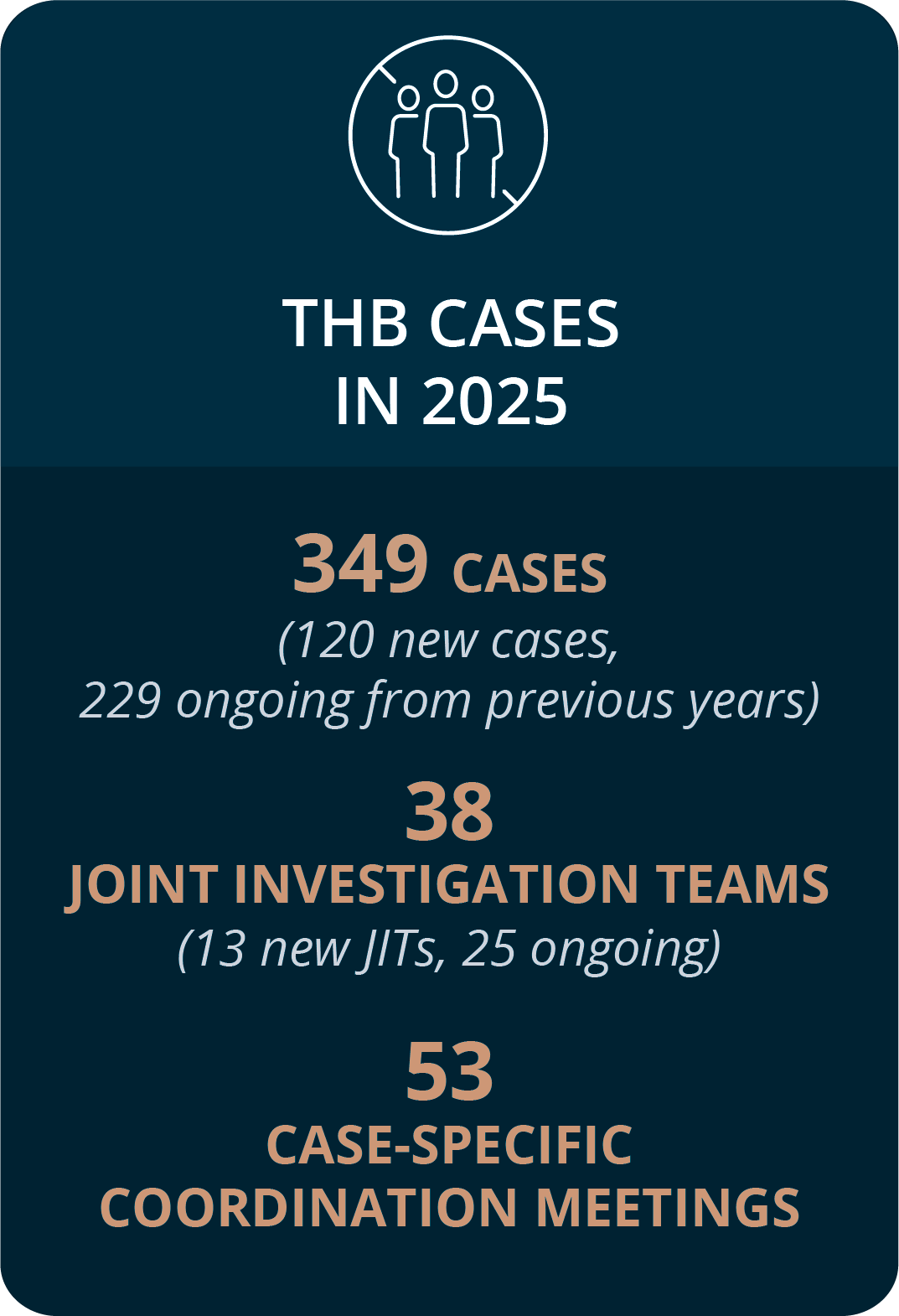
Eurojust continued to assist national judicial authorities with close to 350 cases in 2025. Eurojust also supported 53 coordination meetings, demonstrating the need for cross-border judicial coordination.
Romania opened the highest number of human trafficking cases in 2025, followed by Italy and Hungary. Romania, Germany, Spain and France were the EU countries most frequently requested to assist in Eurojust’s cross-border THB cases in 2025. Switzerland was the third country that initiated the most human trafficking cases at the Agency in 2025, while the United Kingdom was the most frequently requested third country to contribute to international investigations in this area.
19 individuals detained, suspected of trafficking and pimping Romanian women
CRIME: A criminal group gains over EUR 1.7 million by exploiting over 30 Romanian women for prostitution on the streets of Italy. Victims are lured into the network using the lover boy method and are convinced that prostitution is a necessary sacrifice to contribute to the financial well-being of the group.
ACTION: Through a JIT, authorities uncover the pyramid-type structure behind the human trafficking network and plan an action day in Italy and Romania to arrest members of the group and bring their victims to safety.
RESULT: The action day leads to the detention of 19 suspects and judicial control for two individuals. During searches executed in 25 places, authorities seize firearms, cash and luxury vehicles.
EUROJUST'S ROLE: To coordinate the investigation, Eurojust sets up a JIT and organises several coordination meetings in The Hague and abroad. Eurojust supports national authorities in identifying which suspects are investigated for the same facts, to avoid infringement of the ne bis in idem principle. On the basis of Eurojust's advice, the authorities agree to concentrate the proceedings in Romania, which is considered best placed to prosecute the case.

Strategic developments impacting Eurojust’s human trafficking casework
Eurojust’s support for judicial cooperation in THB cases has remained steady; however, the Agency has identified several challenges related to cross-border cooperation in complex trafficking cases such as:
- The cross-border nature of cases often requires coordinated parallel investigations that are not always fully supported by all countries involved.
- Organised crime groups are increasingly sophisticated, with profits that are difficult to trace and confiscate.
- Identifying and locating all victims remains challenging as well as securing victims’ testimonies
- The growing use of digital tools and social media for recruitment and exploitation overwhelms investigators with large data volumes and demands specialised expertise to process them (so it can be used as admissible evidence in criminal proceedings).
Eurojust is continuing its effort to improve the criminal justice response to cross-border human trafficking cases, including through its dedicated Focus Group on Trafficking in Human Beings. The Focus Group serves as an important hub for regularly connecting specialised judicial actors at the national level in the EU Member States and beyond. In 2025, the Group members exchanged experiences and best practices on a range of topics and also shared information on new trends in this crime area, including the latest developments in the role of AI in human trafficking, as well as in the areas of trafficking for the purpose of organ removal, benefit fraud and trafficking involving minors.
 Eurojust is an agency of the European Union