
In July 2025, the European Commission published its first evaluation of the Eurojust Regulation[2], examining its implementation between the end of 2019 and 2024[3]. In such exercises, the European Commission assesses how well the law works in practice: whether it achieved its objectives, and how effective it has been.
2.1. 2020-2025: a changing agency - growing with the challenge
In these years, Eurojust has functioned as a cornerstone of Europe’s criminal justice architecture. The period also brought significant changes to the work of Eurojust and the wider justice community.
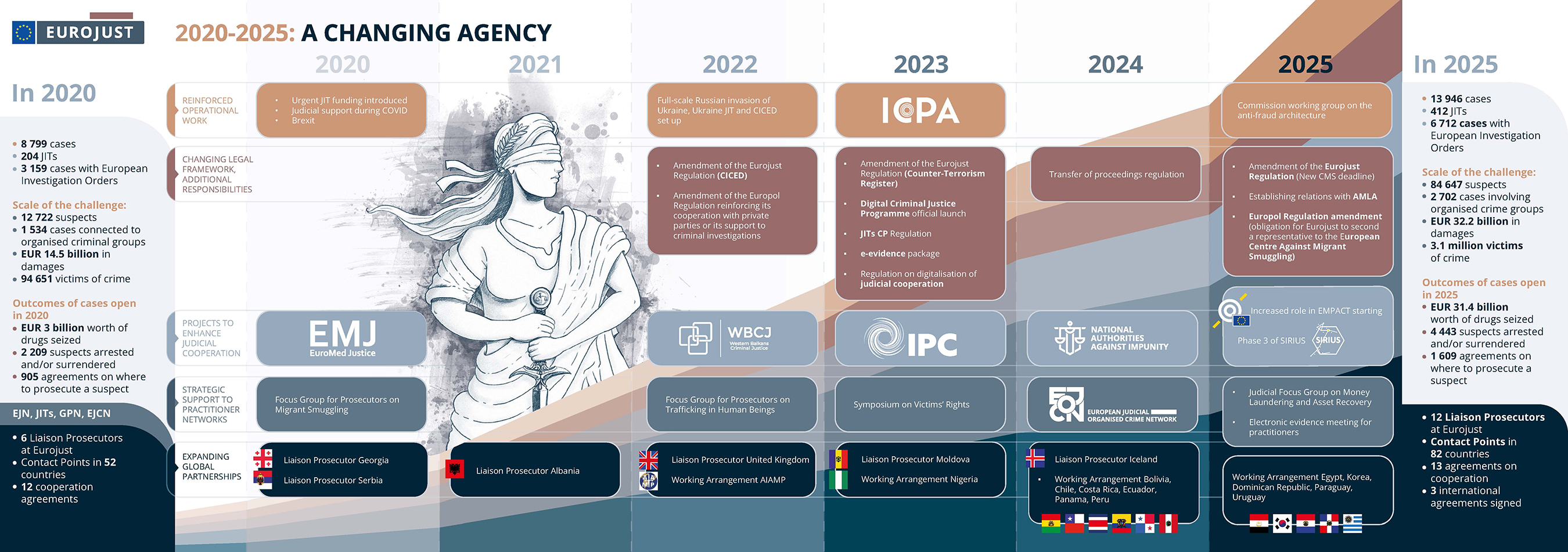
Numbers speak volumes: between 2020 and 2025, cases supported grew by close to 60%, the number of supported JITs more than doubled, as did the number of cases involving a European Investigation Order. The scale of the challenge also grew: in cases open in 2025, compared to those open in 2020, criminals caused 122% more damages and impacted a staggering 3175% more victims. Comparing these two sets of open cases, Eurojust was facilitating the seizure of 946% more drugs, more than double the arrests or surrenders and 77% more agreements on where to prosecute a crime in 2025.
Beyond the quantitative changes, Eurojust’s work also improved in quality, adapting to the evolving legal and political environment and the needs of practitioners. Without aiming for completeness, the following graph illustrates the most important developments for Eurojust:
Hover to zoom · On mobile, tap to explore full-screen
[1] Evaluation of the European Union Agency for Criminal Justice Cooperation SWD(2025)183 final (Evaluation Report) p44
[2] The Commission’s evaluation report relies on a study conducted in 2024 that was drafted based on interviews with 117 Eurojust stakeholders, online surveys with over 400 responses from prosecutors at Eurojust and national level practitioners, desk research, direct observations and focus groups with participants from 10 countries.
[3] The exact period spans from 12 December 2019 to 1 May 2024.
 Eurojust is an agency of the European Union