Drug trafficking remains one of Europe’s fastest-growing security threats and, for another consecutive year, was the second most frequently addressed crime type at Eurojust.
Eurojust’s operational support to drug trafficking cases
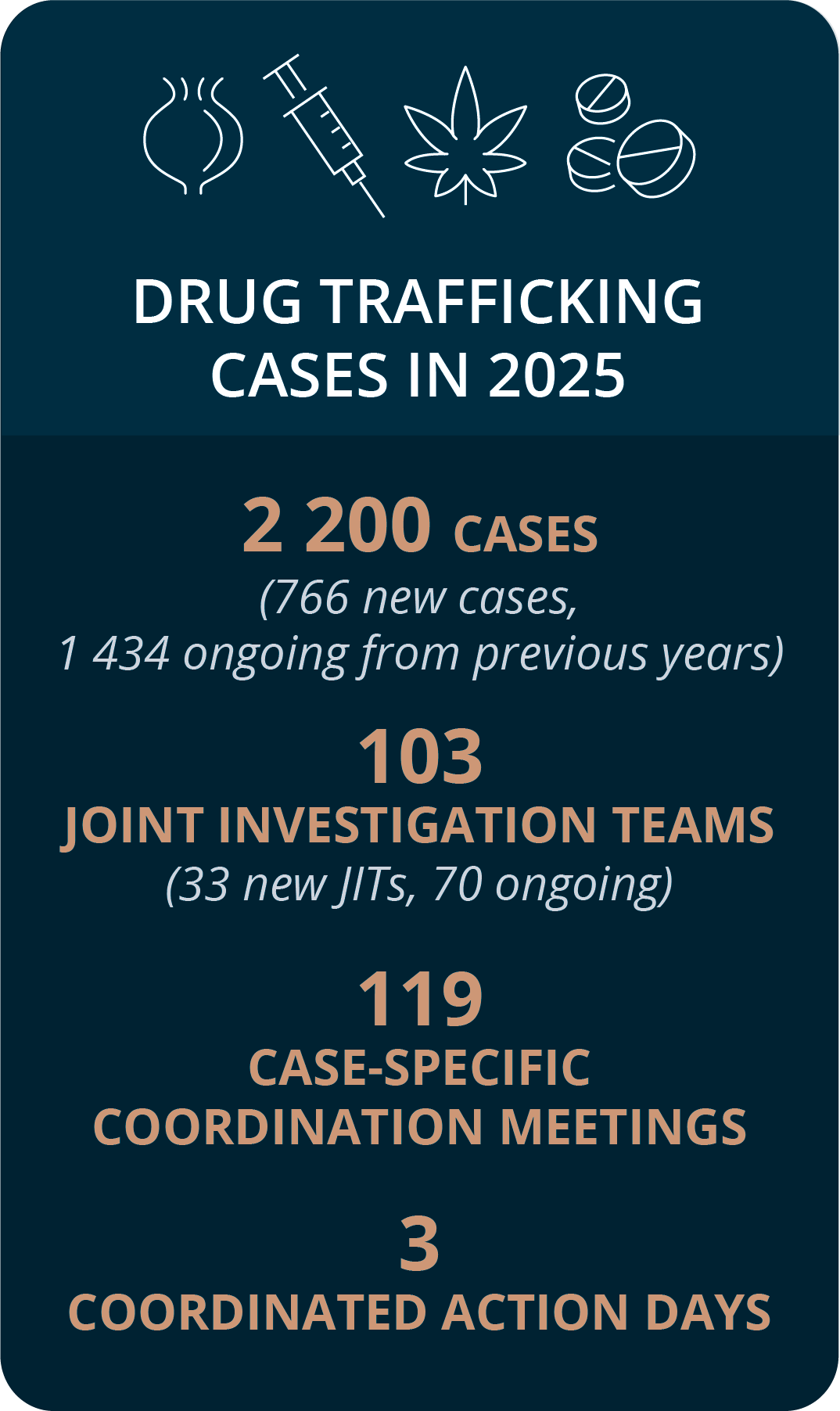
In 2025, the Agency managed 2 200 cases, including more than 750 new investigations. Over 100 coordination meetings and JITs were organised to strengthen judicial cooperation in dismantling drug trafficking networks and advancing prosecutions.
Drug trafficking remains one of the main sources of income for organised crime, with the market expanding as the availability of illicit drugs increases – particularly cocaine from South America. As a result, cooperation with non-EU countries is becoming increasingly important. The threat is also characterised by rising levels of violence, the exploitation of minors, the widespread use of encrypted communication tools and a growing number of cases involving synthetic drugs.
In 2025, Italy initiated the highest number of cross-border drug trafficking cases at Eurojust, followed by Germany. Spain was the most frequently requested country, ahead of France and the Netherlands. Requests for cooperation with third countries also increased. Among third countries, Albania initiated the most cases, while the United Kingdom, followed by Serbia, was most often requested to assist in cases.
A significant share of cases continued to stem from data obtained from encrypted communication platforms used by organised crime groups, such as EncroChat and Sky ECC, posing major technical, legal and resource challenges, particularly for data retention and analysis.
Dismantling a major drug trafficking network with links to Latin America
CRIME: An OCG traffics illicit drugs worth at least EUR 175 million across the European Union. By setting up legitimate companies that trade and transport legitimate goods, the illegal activities are hidden.
ACTION: Nearly 580 law enforcement officers are involved in coordinated actions taking place in Hungary, Slovakia, Germany and Spain. During searches, authorities not only find various drugs ready for transport, but also an illegal cigarette production line.
RESULT: Authorities arrest 22 suspects, including the alleged leader of the criminal group. Over EUR 370 000 in cash, various drugs, documents, phones and other communication tools are seized.
EUROJUST'S ROLE: Eurojust supports the Slovak-Hungarian JIT and assists with the execution of EAWs and EIOs. To ensure all measures are implemented on the action day, a coordination centre is set up at the Agency.

Strategic developments impacting Eurojust’s drug trafficking casework
In December 2025, the European Commission presented the EU Drugs Strategy and Action Plan, alongside revised rules on drug precursor control. Eurojust plays a central role in the strategy’s operational delivery by supporting prosecutions and strengthening judicial cooperation, including through close collaboration with EU partners and Latin American and Mediterranean countries.
Main organisers of drug transports to Nordic countries arrested
CRIME: Five suspects organise the long-term, large-scale transport of drugs to Sweden, Finland, Denmark and Norway. The drugs are transported via France and Germany in trucks with secret compartments. Afterwards, local criminal groups sell and distribute the drugs.
ACTION: After the previous arrest of eight members of the network, authorities work together to disrupt the transport route and arrest five more members of the criminal group.
RESULT: An operation in Serbia leads to the arrest of five suspects and the seizure of several encrypted mobile phones, documents, a firearm and ammunition.
EUROJUST'S ROLE: To consolidate ongoing investigations into the transport network, a JIT is set up at Eurojust. The Agency provides logistical, organisational and financial support to the JIT.

 Eurojust is an agency of the European Union