
Migrant smuggling is a global criminal activity driven by profit and disregard for human life, involving the illegal movement of people across borders. It is typically carried out by organised, multinational criminal networks that exploit migrants’ vulnerability, often resulting in violence, abuse, exploitation and loss of life. These networks include all actors in the smuggling chain – from recruitment and logistics to transport, equipment supply and payment collection – and frequently use digital platforms to advertise, recruit, coordinate operations and receive payments.
Eurojust’s operational support to migrant smuggling cases
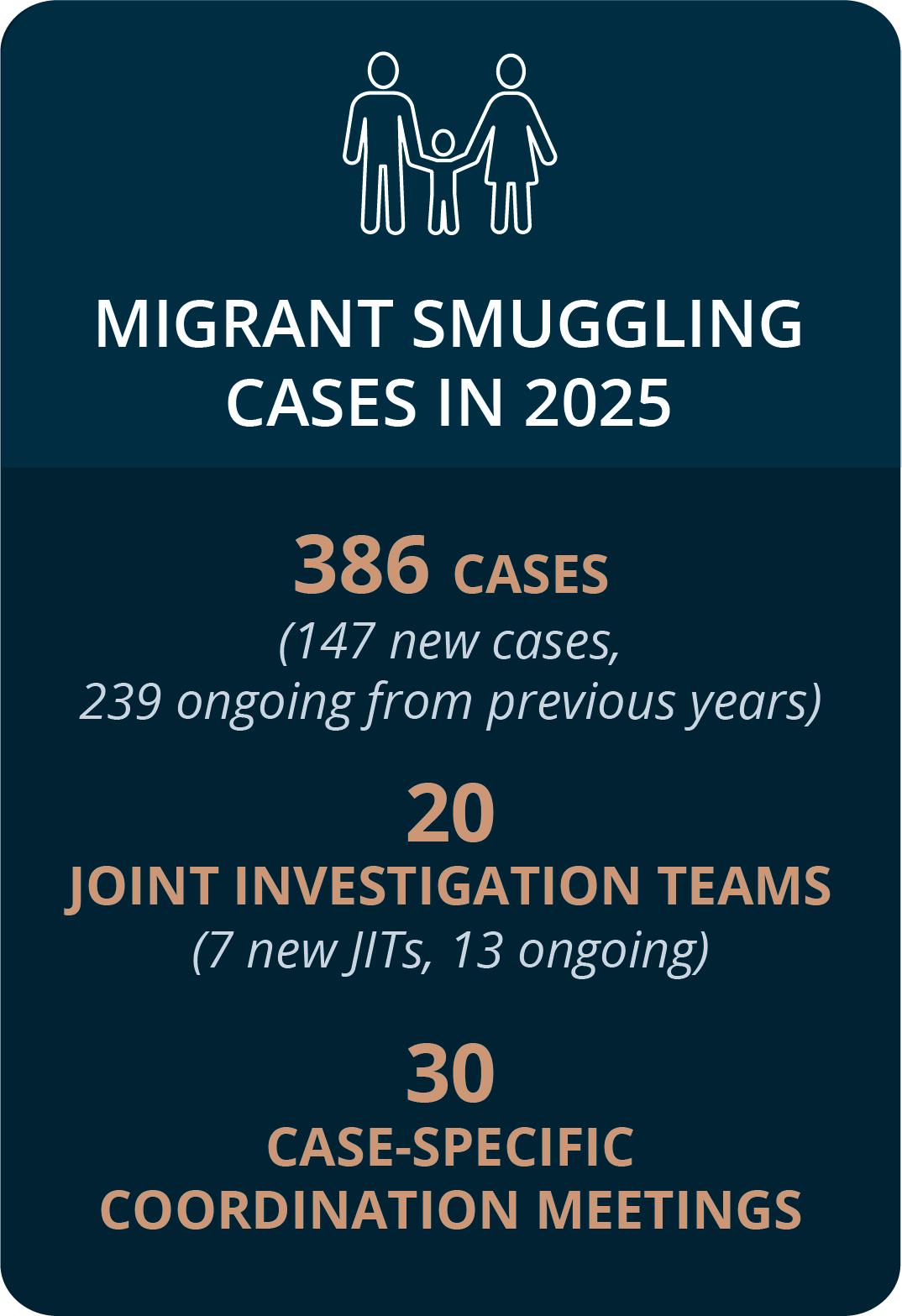
The number of migrant smuggling cases supported by Eurojust remained steady with only a slight increase in case numbers compared to the previous year. During the reporting period, the Agency supported 386 cases.
Greece opened the largest number of migrant smuggling cases, followed by Germany. Germany, followed by Bulgaria, was the EU country most frequently requested to participate in Eurojust’s cross-border migrant smuggling cases in 2025.
Cooperation with third countries in migrant smuggling cases is vital but can be challenging. The presence of Liaison Prosecutors at Eurojust helps to overcome obstacles to efficient cooperation. The United Kingdom and Albania were the third countries that initiated the most migrant smuggling cases at the Agency in 2025. The United Kingdom and Georgia were the most requested third countries to contribute to international investigations in this area.
Taking down a criminal group suspected of smuggling up to 300 migrants
CRIME: A smuggling network active in Belgium, Germany and Poland smuggles migrants from Middle Eastern countries into the EU. Up to 22 people at a time are illegally transported along the Balkan route. Legitimate car rental services in several countries are used to conceal their activities.
ACTION: Investigations into the group started following a routine immigration check where evidence emerges that the driver has already smuggled illegal migrants that same day. Authorities then discovered the larger network that the driver was a part of.
RESULT: A joint operation in Belgium and Germany leads to the arrest of seven suspected members of the smuggling network. An earlier operation in Poland already saw 10 suspected members being arrested.
EUROJUST'S ROLE: Through coordination meetings set up at Eurojust, authorities exchange valuable information on the network and develop a joint judicial strategy.

Given the rise in complexity and challenges relating to prosecuting migrant smuggling cases, Eurojust’s expertise as a pan-European judicial hub is invaluable. These challenges include:
- digitalisation in migrant smuggling, with organised criminal networks using online platforms, encrypted communications and cryptocurrencies, complicating judicial and financial investigations;
- increasingly complex and fragmented smuggling networks operating across the EU, marked by violence, extortion and the use of minors, which makes cross-border investigations more difficult; and
- challenges in cooperation with some third countries, where limited legal cooperation and differing legal frameworks allow key criminals to evade justice.
The posting of Liaison Prosecutors at Eurojust and the growing number of connections between the Agency and non-EU countries are helping to address these challenges.
 Eurojust is an agency of the European Union