
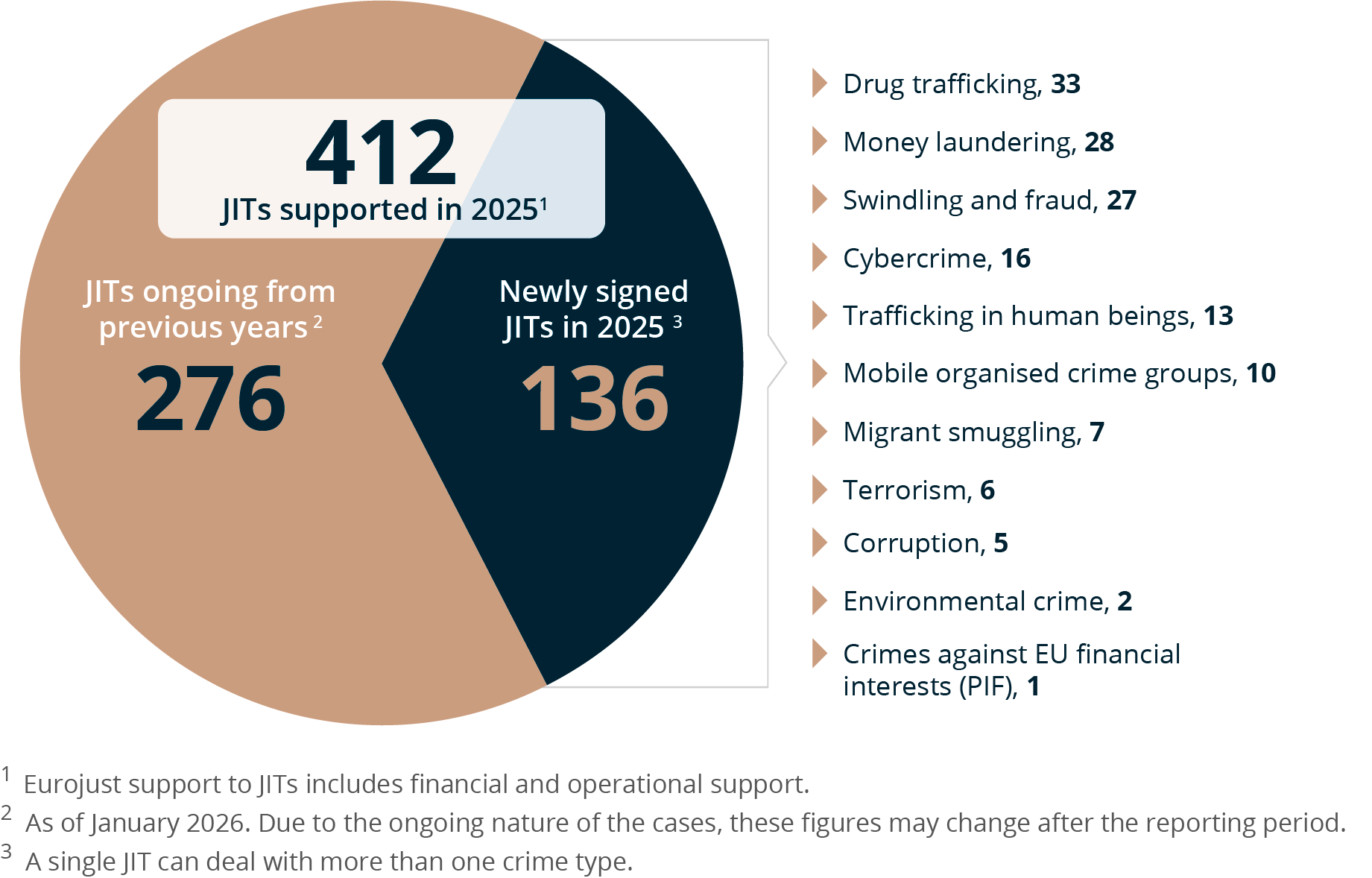
Joint investigation teams are an advanced tool for judicial cooperation supported by Eurojust. In 2025, the Agency supported 11% more JITs than in 2024, continuing the upward trend from previous years. Eurojust facilitated 412 JITs throughout the year, approximately one third of which were newly signed in 2025.
JITs were used in several major cross-border cases involving both EU Member States and third countries. The newly signed JITs in 2025 covered a wide range of crime types: the largest number of JITs were established to tackle drug trafficking (33) and money laundering (28).
Decisive action against scammers targeting victims in Austria and Latvia
CRIME: Over 3 000 victims are defrauded of several million euros by a criminal network offering its scam models and technical tools to other criminals as a crime-as-a-service. Their online service provides phone numbers from over 80 countries and entire infrastructures to set up fake accounts on social media.
ACTION: Cooperation between Austrian, Estonian, Latvian and Finnish authorities, together with Eurojust, uncovers the different methods offered by the criminal network. Joint actions are planned to arrest the suspected members of the network and take down their servers.
RESULT: Seven members are arrested, five servers are taken down and a SIM-card based technical system, along with 40 000 active SIM cards, is dismantled.
EUROJUST'S ROLE: Eurojust supports and finances a JIT, enabling the authorities to work together swiftly and efficiently.

Eurojust JITs funding programme
Eurojust funded close to half of the 412 JITs supported by the Agency in 2025. During the year, the JITs Network Secretariat received 403 funding applications and awarded 365 grants under the standard funding scheme and 25 grants under the urgent funding scheme.
Through these grants, Eurojust provided financial support to 199 active JITs (75 of these JITs were established in 2025). The JITs funding programme budget for 2025 was EUR 2.1 million.
The increase in the number of funding applications submitted (by almost 15% compared with 2024) and in the amounts requested (by more than 20%) highlights the importance of financial support for the functioning of JITs. Most of the awarded grants were used for translation and interpretation, as well as for the purchase of equipment.
The Claims Module, an online tool for submitting JITs funding reimbursement claims, continued to be used successfully in 2025 and will be the sole method for submitting reimbursement claims and extension requests from 2026.
JIT evaluation
In 2025, the Fifth JITs Evaluation Report was published, based on 67 completed JIT evaluations. The findings show that the early involvement of Eurojust and the timely agreement on the scope of the JIT remain key factors for smooth cooperation, particularly in cases involving several parallel national investigations. The evaluation found that challenges related to:
- the exchange and use of evidence,
- the coordination of investigative measures, and
- the alignment of prosecution strategies
become more pronounced in multilateral JITs.
It also shows that seconded members, regular coordination meetings, and early discussions of jurisdictional issues help to mitigate these risks.
Throughout 2025, the JITs Network Secretariat continued to contribute to training activities for JIT practitioners at both EU and regional levels, together with Eurojust's Western Balkans Criminal Justice Project.
Work on the JITs Collaboration Platform also continued throughout 2025.
 Eurojust is an agency of the European Union