
Belgian, German and UK authorities continue to work together to disrupt migrant smuggling networks operating along the English Channel. A joint investigation team, set up at Eurojust and supported by Europol, focused on targeting the smuggling supply chain. During an international operation, four individuals suspected of organising the delivery of nautical equipment were arrested.
The investigation, launched in 2025, targeted a criminal network supplying equipment for dangerous crossings of the English Channel using small inflatable boats. The equipment was manufactured in Asia and imported into Germany from Türkiye via sea and land routes. After the equipment arrived in Germany, it was assembled into packages, worth over EUR 10 000 on the black market. The packages contained items such as inflatable boats, engines, pumps, petrol jerry cans and tyre inner tubes that would be used as makeshift lifejackets, dangerous buoyance aids or other purposes.
The packages were then sold to migrant smuggling networks in Northern France for use in Channel crossings. It is estimated that the criminal network earned up to EUR 100 000 per boat that crossed the Channel. In 2025 alone, more than 41 000 migrants and 670 boats successfully reached the United Kingdom. The journey over the Channel remains extremely dangerous; over 31 migrants lost their lives during these crossings.
Given the cross-border nature of the criminal activity, judicial cooperation was essential. A joint investigation, set up at Eurojust, enabled Belgian and UK authorities to work together, exchange evidence and information, and decide on a prosecutorial strategy. Eurojust also facilitated cooperation with German authorities to prepare for the action day on 25 March 2026. European Arrest Warrants and European Investigation Orders were prepared by Eurojust to support the operation.
Europol supported the investigation by facilitating operational coordination, organising operational meetings and enabling the exchange and analysis of intelligence, which helped identify links between multiple national investigations. On the action day, Europol deployed two experts on the ground to assist German authorities with operational coordination and handle cross-checking of operational information against Europol’s databases in real time.
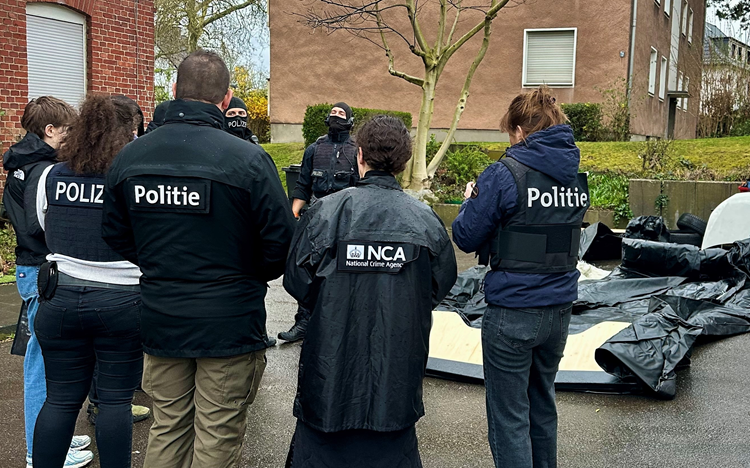
During the action day, four suspected organisers were arrested who are all considered high-value targets. During the ongoing searches, 12 in Germany and two in Belgium, 33 mobile phones, 11 small boats, one engine, several life vests, more than EUR 50.000, two rifles and one pistol were seized so far. This action day follows earlier ones in which 21 suspects with low-level logistical roles in the criminal network were arrested.
- Belgium: Investigating Judge in West Flanders, Bruges; Federal Public Prosecutor’s Office; Federal Judicial Police
- Germany: General Public Prosecutor’s Office in Hamm; Public Prosecutor’s Offices in Düsseldorf and Essen; German Federal Police
- United Kingdom: Crown Prosecution Service; National Crime Agency
 Eurojust is an agency of the European Union