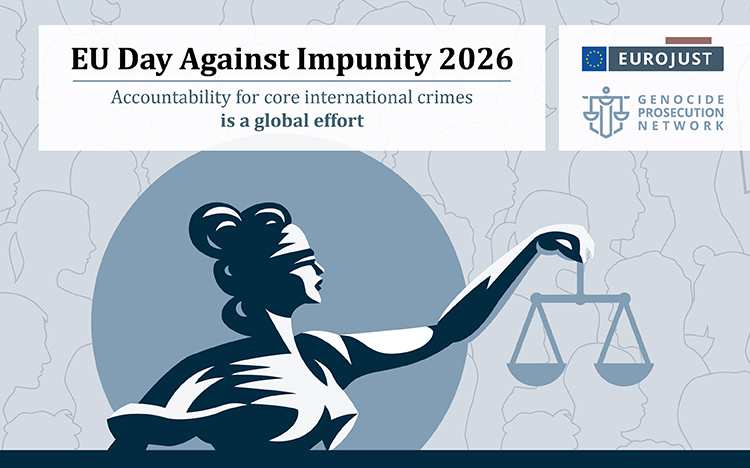
On 23 May, the European Union marks the 11th EU Day Against Impunity for genocide, crimes against humanity and war crimes. At a time of growing armed conflict around the world – particularly in regions close to the European Union – and mounting threats to the international criminal justice system, this day serves as a reminder of the commitment needed to fight impunity for the most serious international crimes.
Accountability for core international crimes is a global effort. Across Europe and beyond, national authorities, international institutions and civil society organisations are working together to strengthen international criminal justice worldwide. EU Member States make a particularly significant contribution to justice for victims through the exercise of extra-territorial jurisdiction, including universal jurisdiction. In 2025, over 30 new cases were opened, adding to the ongoing investigative and prosecutorial efforts in 20 countries concerning crimes committed in over 30 countries*.
Since 2016, Eurojust and the Genocide Prosecution Network have marked the EU Day Against Impunity on 23 May to raise awareness of the most heinous crimes and to support national investigations and prosecutions.
Hosted at Eurojust, the Genocide Prosecution Network facilitates close cooperation between national authorities investigating and prosecuting the crime of genocide, crimes against humanity and war crimes. Through its biannual meetings, the Network provides a platform for practitioners to exchange operational information, experience and best practices.
In recent months, several landmark cases have brought significant progress on accountability for core international crimes. In Sweden, an appeal produced the first conviction for genocide through the transfer of children. In the Netherlands and France, courts handed down their first convictions for core international crimes committed against the Ezidi community. Investigations and trials were also opened into crimes committed in Rwanda and the Democratic Republic of the Congo, including a trial in France for crimes against humanity. In Belgium, an indictment was filed in Belgium against a suspect for war crimes and crimes against humanity committed in Liberia.
Corporate accountability has also advanced in recent years, with ongoing judicial investigations into cases against several corporations allegedly linked to complicity in core international crimes. Cases based on universal and extra-territorial jurisdiction not only aim to bring perpetrators to justice but also contribute to strengthening victims’ rights, including access to reparations.
Considerable efforts are also being directed at accountability for crimes committed in Ukraine, notably through the establishment and commendable work of the dedicated Joint Investigation Team (JIT). Despite challenges facing investigations and prosecutions, an important milestone was reached in Finland, where, for the first time, a Russian national was convicted on the basis of universal jurisdiction for war crimes committed in Ukraine in 2014.
On this EU Day Against Impunity, we reaffirm our unwavering commitment to accountability for core international crimes. We also honour victims and survivors, and recognise the crucial role played by practitioners in the fight against impunity.
* TRIAL International, Universal Jurisdiction Annual Review 2026 (2026).
 Eurojust is an agency of the European Union