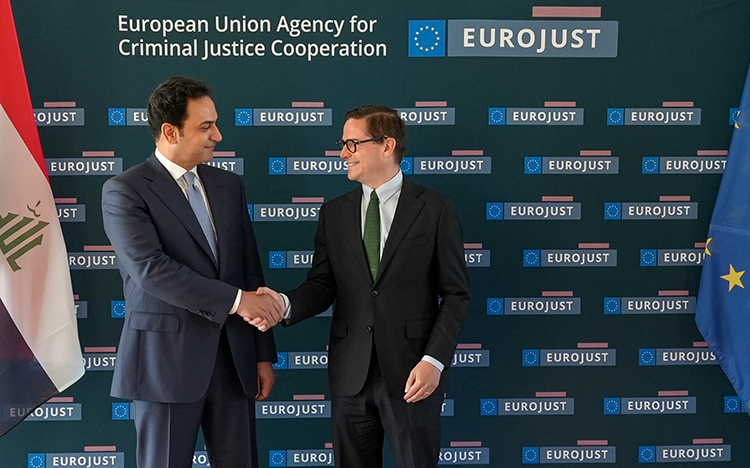
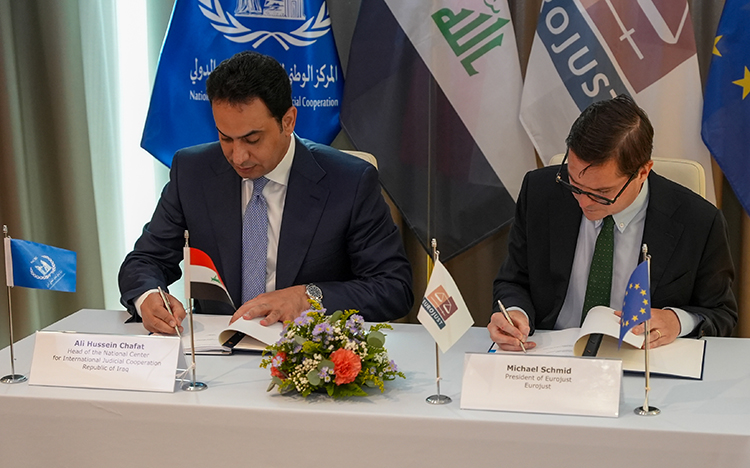
 Eurojust President, Michael Schmid and Judge Ali Hussein Chafat, representative of the Supreme Judicial Council of the Republic of Iraq and Head of the National Center for International Judicial Cooperation signed a Working Arrangement today at the Eurojust headquarters in The Hague to enable long-term cooperation in the fight against terrorism and serious and organised crime. The arrangement provides a framework for strategic cooperation and the exchange of information between the Agency and the authorities of the Republic of Iraq.
Beyond making the thirteenth such working arrangement for Eurojust, outside the European Union, the agreement represents an important step forward in supporting EU Member States investigating crimes committed by ISIL/Da’esh and cases involving foreign terrorist fighters. The Working Arrangement will strengthen judicial cooperation and facilitate access to information and evidence relevant to terrorism and core international crimes investigations.
Eurojust President, Michael Schmid said: In the pursuit of accountability for terrorism and other core international crimes, experience has shown that no country can succeed alone. I am therefore honoured to welcome our partners from the Iraqi National Centre for International Judicial Cooperation (NCIJC), led by Honorary Judge, Mr Ali Hussein Chafat. With Eurojust supporting 26 investigations into core international crimes in 2025 alone, our operational work in this field continues to grow year after year. We are committed to continuing this trend, and the Working Arrangement signed today with the NCIJC marks an important milestone in our cooperation. It provides a foundation for deeper collaboration and more effective judicial cooperation in the future, and I am confident that it is only the beginning of an even closer partnership between our institutions.
Honorary Judge, Ali Hussein Chafat, representing the Supreme Judicial Council of the Republic of Iraq and Head of the National Center for International Judicial Cooperation Delegation, said: The signing of the Working Arrangement with Eurojust represents an important milestone in the development of judicial cooperation between the Republic of Iraq and the Member States of the European Union, in line with the Supreme Judicial Council's vision to strengthen international judicial partnerships. This agreement reflects the mutual trust and shared commitment to combating terrorism, organised crime, and serious international crimes, reinforcing the principle of accountability and the fight against impunity. This Working Arrangement will contribute to enhancing cooperation mechanisms and the exchange of information and expertise in support of investigations and prosecutions of mutual interest. As Iraq continues to play a pivotal role in countering terrorism and in preserving and managing evidence related to terrorist crimes, this agreement will provide a more effective practical framework for facilitating access to evidence and strengthening international judicial coordination through the joint efforts of the National Center for International Judicial Cooperation and our partners at Eurojust. We look forward to this agreement serving as the foundation for a sustainable strategic partnership with Eurojust, one that advances justice, upholds the rule of law, and contributes to security and stability at both the regional and international levels.
Bartjan Wegter, the EU Counter-Terrorism Coordinator, said: The investigation and prosecution of ISIL/Da’esh crimes remain essential for social peace in Iraq and in the region. Investigations and prosecutions bring justice for the victims and send a clear signal against impunity. In some EU Member States, foreign terrorist fighters have already been cumulatively prosecuted and convicted for both core international crimes and terrorism-related offences. We need to use all relevant evidentiary holdings. I will support enhanced cooperation between Eurojust and the Iraqi National Centre for International Judicial Cooperation to facilitate the prosecution of foreign terrorist fighters. I very much appreciate the Working Arrangement between Eurojust and Iraq which is an important step forward.
The signing of the Working Arrangement is of particular importance for EU Member States in the fight against terrorism and core international crimes. Following the closure of the United Nations Investigative Team to Promote Accountability for Crimes Committed by Da’esh/ISIL (UNITAD) in September 2024, Iraq’s National Centre for International Judicial Cooperation (NCIJC) became the main repository of evidence relating to crimes committed by ISIL/Da’esh, including material relevant to investigations involving foreign terrorist fighters.
Since the transfer of UNITAD’s evidentiary holdings, the Iraqi authorities have made significant efforts to expand and further develop the database. The material includes witness testimonies, data extracted from ISIL digital devices, findings from field investigations and evidence recovered through advanced forensic techniques.
As the primary counterpart for accessing this evidence, the NCIJC plays a key role in supporting European investigations and prosecutions. The Working Arrangement signed with Eurojust marks an important step in strengthening judicial cooperation and facilitating access to evidence that may support European investigations and accountability efforts.
Under the Working Arrangement, EU Member States are strongly encouraged to contact Eurojust before submitting requests for information or mutual legal assistance to the Iraqi authorities. Eurojust will assess the level of support required, facilitate consultations with the NCIJC and assist national authorities in identifying the most appropriate channels for cooperation. In addition, the NCIJC has developed guidance documents and practical templates to support requests for evidence and information, all of which can be found annexed to the Working Arrangement.
Eurojust cooperation with Iraq places particular emphasis on combating terrorism, core international crimes and organised crime. Iraq remains a key partner in efforts to fight impunity for these offences. Judicial authorities have also highlighted the importance of enhanced cooperation with Iraq, as former ISIL members are increasingly involved in organised criminal activities and exploit transnational criminal networks, including drug trafficking, to generate revenue and potentially support or facilitate future terrorist activities.
Previous cooperation between Iraqi authorities, Eurojust and EU Member States has already contributed to landmark convictions, including recent cases involving foreign terrorist fighters.
The cooperation between Eurojust and the Republic of Iraq and its National Center for International Judicial Cooperation have benefitted from the support of EU-ACT: EU Action Against Organised Crime and Terrorism, a cooperation programme under the EU's Global Illicit Flows Programme (GIFP) designed to be an effective EU mechanism to assist partner countries in their efforts to tackle transnational organised crime.
Background:
Eurojust: As the EU hub for criminal justice cooperation, Eurojust is actively connected to over 80 jurisdictions worldwide. To bring non-EU Member States closer together in the fight against serious cross-border crime, Eurojust is facilitating closer working relations by signing Working Arrangements that enable more structural long-term cooperation.
Working Arrangements allow the exchange of strategic information and best practices, and can facilitate access to Eurojust's tools for operational cooperation in investigations involving at least one EU Member State. Working Arrangements do not allow for the sharing of personal operational data. Learn more about Eurojust’s cooperation outside the EU’s borders here, including key data from the Agency’s casework in the past year.
The EU Internal Security Strategy, adopted in April 2025, and the ProtectEU: Agenda to Prevent and Counter Terrorism, published in February 2026, both underline the importance of ensuring that Member States retain access to battlefield evidence collected by UNITAD, which is essential for the prosecution of foreign terrorist fighters. To this end, the European Commission, together with Eurojust, will facilitate the use of the evidence through enhanced cooperation between Eurojust and the National Centre for International Judicial Cooperation of Iraq, as well as exploring whether case-related information could be stored in Eurojust’s Core International Crimes Evidence Database (CICED).
The press release is available in Arabic, with a translation kindly provided by the Iraqi National Center for International Judicial Cooperation
 Eurojust is an agency of the European Union