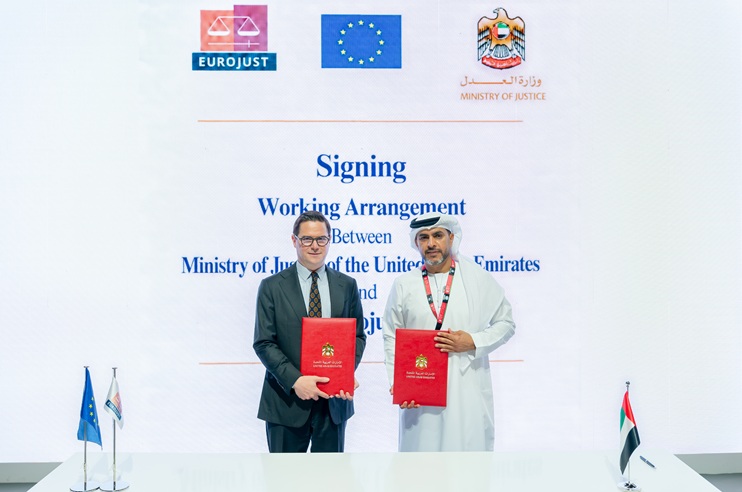
Minister of Justice of the United Arab Emirates (UAE), His Excellency Abdullah Sultan bin Awad Al Nuaimi and Eurojust President, Michael Schmid have signed a Working Arrangement to strengthen cooperation in the fight against serious cross-border crime.
The Working Arrangement provides a framework for closer strategic cooperation and information exchange between Eurojust and the competent authorities of the UAE. It was signed in the margins of the United Nations Congress on Crime Prevention and Criminal Justice in Abu Dhabi.
The Working Arrangement is the 14th of its kind that Eurojust has signed with a country outside the European Union, further expanding the Agency's global network of judicial cooperation partners.
As serious and organised crime increasingly extends beyond national borders, closer cooperation with judicial authorities outside the European Union is essential. The UAE is a partner of high operational relevance in the fight against organised crime. Eurojust’s Strategy on Cooperation with International Partners 2024–2027, specifically identifies the Gulf as a region where cooperation should be further developed and the UAE as a country with which there is an operational need for closer cooperation.
Judicial cooperation with the UAE concerns tackling a range of serious crimes, ranging from fraud, (including VAT fraud) to drug trafficking, money laundering, property crime and cybercrime. Certain organised crime groups targeting the European Union have also used the UAE as a base from which to remotely direct criminal activities, including drug trafficking, money laundering and underground banking.
Today's signature builds on growing cooperation between Eurojust and the UAE. UAE authorities have already participated in operational and strategic meetings and study visits to Eurojust and appointed a Eurojust Contact Point. Cooperation was further strengthened through a joint expert workshop in July 2025.
Background
Eurojust: As the EU hub for criminal justice cooperation, Eurojust works with judicial authorities around the world to support the investigation and prosecution of serious cross-border crime. Its international cooperation is supported by a global network of Contact Points connected to over 100 jurisdictions worldwide.
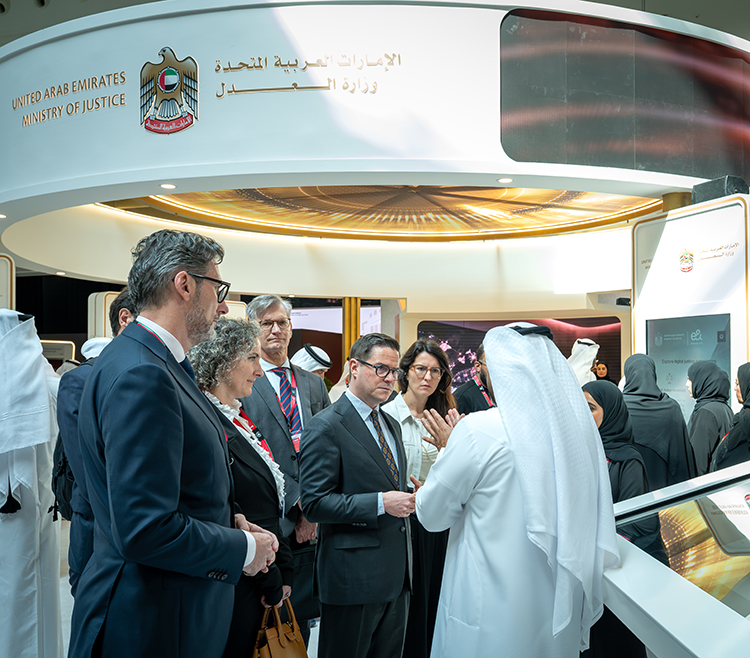
Working Arrangements provide a framework for structured cooperation between Eurojust and the competent authorities of partner countries. They can facilitate strategic cooperation, information exchange and access to Eurojust's operational cooperation tools in cases involving at least one EU Member State. Working Arrangements do not, however, provide a legal basis for the exchange of operational personal data. Such exchanges require an applicable international agreement or other legal basis under the Eurojust Regulation.
Eurojust's Strategy on Cooperation with International Partners 2024–2027 aims to strengthen the Agency's role as a gateway for judicial cooperation between authorities investigating and prosecuting serious crime inside and outside the European Union.
On 10 September 2026, the European Commission recommended that the Council of the EU authorise negotiations for international agreements on cooperation with Eurojust with eight countries: Bolivia, Canada, Chile, Costa Rica, Ecuador, Panama, Peru and the United Arab Emirates. The proposed agreements are intended to provide a legal basis for the systematic exchange of personal data and the secondment of Liaison Prosecutors, subject to safeguards for privacy and fundamental rights. These possibilities are not provided for by the currently signed Working Arrangements.
 Eurojust is an agency of the European Union